
Five Incredibly Frightening Theories About What Might Lie Beyond Our Universe
Popular science for unpopular people

For centuries physicists all over the world, having measured the properties of reality and the universe around us, have argued vociferously and viciously about hundreds of different interpretations of the same set of observable facts.
The Universe, they say, continues to expand ever outwards, filling the empty void of space in much the same way that an off-hand rude comment made during a lull in conversation can fill a party with a passive-aggressive energy. What scientists don’t know, however, is what the Universe is expanding towards. In other words, what lies beyond the boundaries of what we know as time and space.
If they don’t know what exists outside the boundary of the known Universe, they do know what exists outside the boundary of cushy academic positions; a world of endless job interviews and work at companies that demand the occasional met deadline or provable result.
Here are the five theories about what lies beyond the Universe that are crazy enough to fill a listicle, but just plausible enough that theoretical physicists are still allowed to publish entire books around them.
5. A cross-dimensional rest stop
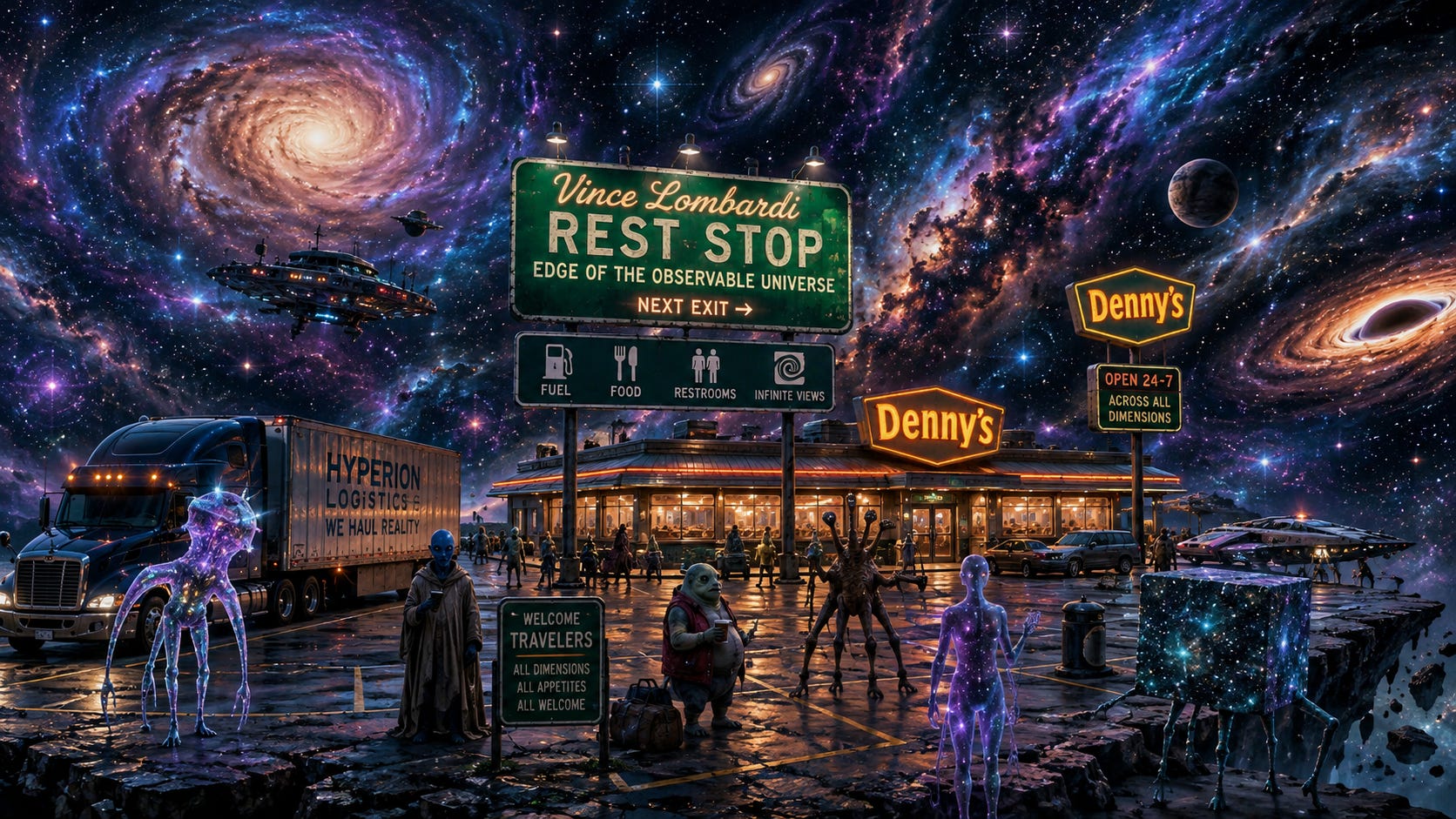
In order for string theory to really work for a theoretical physicist, there have to be 10 or 11 dimensions, most of which are beyond the capacity of a human being – a three-dimensional creature - to imagine, let alone see. In these dimensions you might find four- or five-dimensional creatures observing us.
And when these creatures are traveling across the dimensional planes, they’re going to need a place to stop, stretch their legs, go to the bathroom, buy a bag of chips from a vending machine. Just on the edges of our limits of perception, then, might be the cosmic equivalent of the Vince Lombardi Rest Stop with a trucker’s-welcome Denny’s attached.
4. A Universe where time runs backwards
In a universe comprised of mostly matter, physicists agree that there should be far more antimatter than we actually see. Because the alternative would be that these physicists would have to work harder, as it’s easier to force reality to fit your theory than construct a new theory to fit the observable facts. Hence we might find, at the boundary of our universe, an equal-but-opposite universe where time runs backwards.
In order to imagine what that would feel like, imagine for a second that you are 24 years old living in New York City and you meet a woman you like quite a bit. She invites you to a poetry reading where she is a featured poet. When you show up, the lineup is 17 poets deep and she introduces you to the only other audience member: her boyfriend.
The two of you sit there in silence for the next three and a half hours, because being the only performer that brought audience members she is put at the end of the lineup. This is close, but not entirely identical to, the feeling of time passing backwards.
3. Multiple universes of pure mathematical boredom
This theory posits a very interesting question: “What if mathematics isn’t a tool human beings developed to measure our world and then spent thousands of years refining? What if, instead, mathematics is the raw stuff that reality is constructed from, and your algebra teacher is one of the few humans who could channel this wild elemental force like a sorcerer or high priestess?”
In this interpretation, there are infinite multiple bubble universes just like our own that run on different mathematical constructs. For instance, in our reality E=MC² proves that energy and mass are the same thing, and the sum of the three angles of a triangle always adds up to 180°.
But the next universe over could be run on a mathematical constant that ties the lifespan of a distant star and the numerical difference between the time a plane is supposed to fly out of LaGuardia Airport and the time it actually departs.
This theory was discovered around the same time that pharmacology students at various respected universities began selling their drugs to their respective theoretical physics departments.
2. It’s all a simulation
This is a theory with the unique distinction of being complex enough that it could fill dozens of pages in a prestigious scientific journal while also being dumb enough that it could be grasped by millions of Redditors with no more scientific grounding than watching The Matrix in their rented room while ripping bong hits.
The simulation theory posits that if a civilization becomes technologically advanced enough, it will run millions of different simulations of reality because… reasons. And so therefore, the odds are somehow great that we live in one of those simulations.
To reiterate: A civilization can create a simulation so sophisticated that the programs within cannot distinguish it from reality, and this is the best they could come up with. Because hyper-advanced beings with Godlike powers of creation want to watch millions of vacant-eyed people staring for hours at their phones.
1. Pure nothingness
This is the theory that makes the most scientific sense, and therefore is the one least embraced by the scientific community. After all, nature abhors a vacuum and rushes to fill it as quickly as possible. Just like when the rest of the Kardashians tried to get it into Rob’s head that his stripper girlfriend might not love him for his sparkling personality.
In much the same way, the observable universe keeps expanding outwards to fill the void beyond with as much matter as possible. This, of course, raises questions like, “What was in that void before we were? What caused the Big Bang from which all matter expanded and rushed outwards to begin with? When every world dies, when entropy overtakes reality, when all stars extinguish and all planets and moons crumble to space dust, what comes to take this universe’s place?”
This is the line of inquiry that make any reasonable scientist crawl into bed with a glass of warm milk and a plate of cookies, and thus is not talked about much.
This Substack lives and dies on audience support. Subscribe below - for free! - and enjoy the feeling of supporting a writer while also receiving quality comic essays like this twice a week.
And don’t forget to smash the like button below: