
“I Don’t Care”: The Scene That Makes The Fugitive Work
What The Fugitive, High Noon, and Raiders of the Lost Ark can show us about simple story structures


This week I watched the movie The Fugitive (in its beautiful 4k transfer) for the first time since it came out in 1993. It stars Harrison Ford and Tommy Lee Jones in what was probably the grumpiest set in Hollywood’s history.
Ford stars as Dr. Richard Kimble, who comes home one night to find that his wife has been murdered by a one-armed man. He is the only person who believes this one-armed man exists, and so he’s arrested and convicted for the murder. When Kimble escapes custody in a train crash on his way to prison, Jones’ Deputy U.S. Marshall Sam Gerard is tasked with catching him and bringing him back alive.
Even thirty-three years later, this movie works and the reason is, despite its run time of over two hours, despite the fact that almost the entirety of the film is between two heroes and we don’t even meet the bad guys until act three, and despite the complex chain of events set in motion by Mrs. Kimble’s murder, the story itself is very simple and very easy to follow.
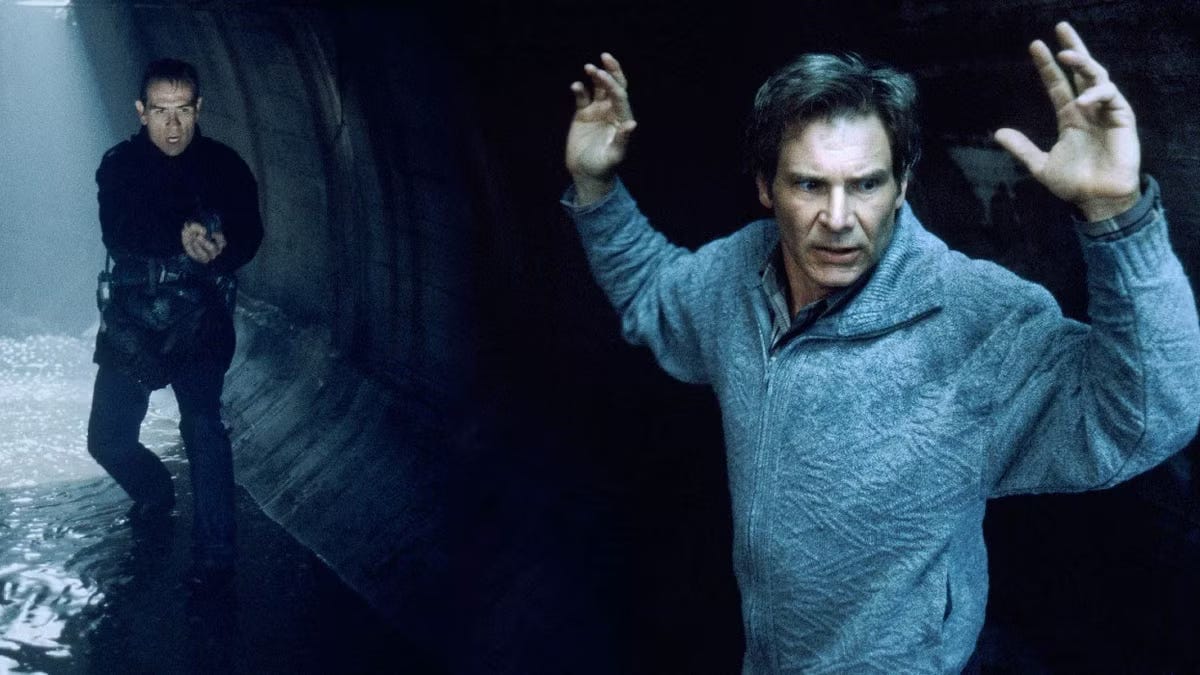
The most famous scene in The Fugitive is the climax of a chase through a series of tunnels that leads to a waterfall down a dam to a 200 foot drop. While the jump down the waterfall is, rightly, remembered as an iconic stunt, it’s the exchange between Deputy Marshall Sam Gerard and Richard Kimble right before that serves as the heart of the film.
Kimble is backed against the opening over the drop. He has Gerard’s gun, and is aiming it at him. He says, “I didn’t kill my wife.”
Gerard responds, “I don’t care.”
It is in this moment that the film turns. Up until now we’d seen Gerard the lawman, Gerard the hound dog hunting his man. In this moment we see something else: Gerard has integrity. He has a moral compass. And he has zero tolerance for even bullshitting his man to trick him into surrendering.
Because Sam Gerard is a good cop. We’re going to see an example of a bad cop when we discover the backstory of the one-armed man, and we’re going to see an example of a morally indifferent cop when the Chief of the CPD orders his men, in the climax, to shoot Kimble on sight without due process. But Gerard is not a judge, jury, or executioner. He is a U.S. Marshall and his job is simply to bring in his fugitive.
And so we get the fun of watching not only Kimble remain one step ahead of the law, but also watching Gerard slowly invest himself in Kimble’s case. We root for Kimble to get away, and we also root for Gerard as we watch him piece the clues together.
This is a movie with two protagonists and two heroes. It shouldn’t work, but again, the story framework is so simple that there’s room for something as unusual as a film where the audience can root for both hunter and hunted.
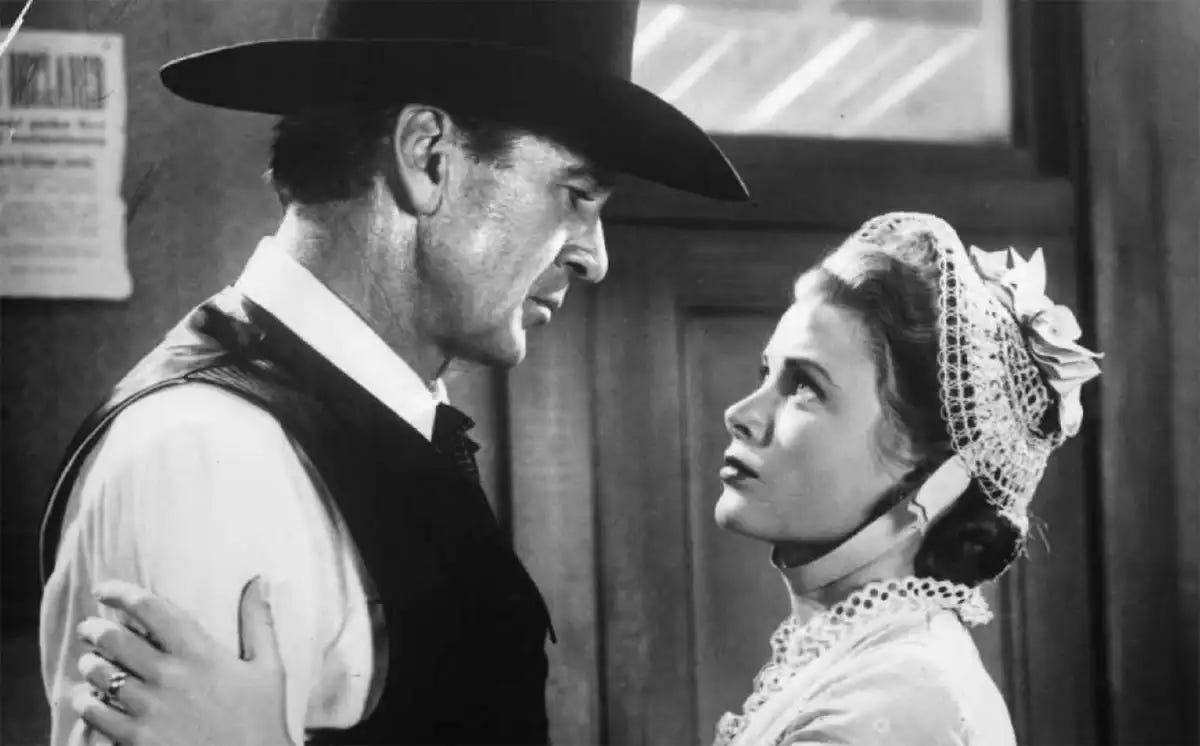
Classic American cinema often played in grey moral areas, even in the most basic stories of good versus evil. High Noon is one of the great American Westerns which is best remembered for Gary Cooper’s resolute heroism and for the impressive production feat that the movie takes place in real time.
But it’s the movie’s refusal, within this simple framework, to back away from uncomfortable moral questions that makes it an enduring classic.
In the film, Cooper’s Will Kane has just retired as the Marshall of Hadleyville, a small western town on the rise. He has just married Amy, played by a never-more-beautiful Grace Kelly, who is a devout Quaker and, for reasons we find out later in the film, an avowed pacifist. The movie starts with Kane and Amy loading a wagon to ride off to start their new lives as shopkeepers in another territory.
However, word has been passed down that Frank Miller, a man whose gang Kane broke up and who was sent to death row for murder, has seen his sentence commuted. He is arriving on the noon train to seek vengeance. Three members of his gang (including a sinister young Lee Van Cleef) await the noon train, and Kane knows that if he leaves town the gang will wreak havoc on Hadleyville and then hunt him down wherever he goes.
And so Kane must stay and face Miller. The tension for the runtime of the film, which is under 90 minutes, stems from the fact that nobody in the town wants to help Will. For some it’s a matter of cowardice. But for others, there are what they believe to be good reasons to see Miller shoot Kane dead.
There are those who liked Miller, and whose businesses did well when he ran the town. For others, there’s the prospect of incoming state aid to build factories and stores, and the fear that news of a shootout on Main Street will mean an end to the money. And there’s the matter of the men who helped him tame the town five years previously being older, having families, and more to lose.
In the end good triumphs over evil, but at a cost to all involved. Amy, who explains that she became a Quaker after seeing her father and nineteen year-old brother shot to death, saves Kane’s life when she picks up a gun and shoots one of Miller’s men in the back. The town cowers indoors and listens as Will, alone, risks his life to save their town one last time. And at the very end, Kane — who started the film proud of his career as a lawman and the work he did protecting Hadleyville — throws his badge in the dust and drives off in disgust.
And while the story remains as simple as any western — good Marshall versus evil cowboy — it’s the conflict within the story that is complex and often heartbreaking.
Thirty years later and three thousand miles away, The Fugitive is playing in the same sandbox.
When he finds the one-armed man Sykes’ home and in it proof that he was involved with his wife’s murder, Kimble calls Gerard — because thanks to the scene in the tunnels, Kimble knows that he can trust Gerard to come to Sykes’ home and objectively put the pieces together.
The audience also knows this because Kimble, when he calls Gerard, explicitly says, “Do you remember what I told you in the tunnel?”
Within the framework of the movie, Kimble uses this as a password to let Gerard know that this isn’t a crank call. Within the framework of the screenplay, it also lets the audience know that the film understands the impact of the tunnel scene as well as we do.
And when Gerard responds that he said that he doesn’t care, we have seen him asking the important questions too many times – “Why did Kimble risk his freedom to return to Chicago?” “Why is he still searching for this one-armed man that his own defense team says doesn’t exist?” – to believe this to still be true.
We’re excited because we know that he knows that Kimble might be innocent, and we are now rooting for him to trace the phone call and follow his instincts to the real killer.
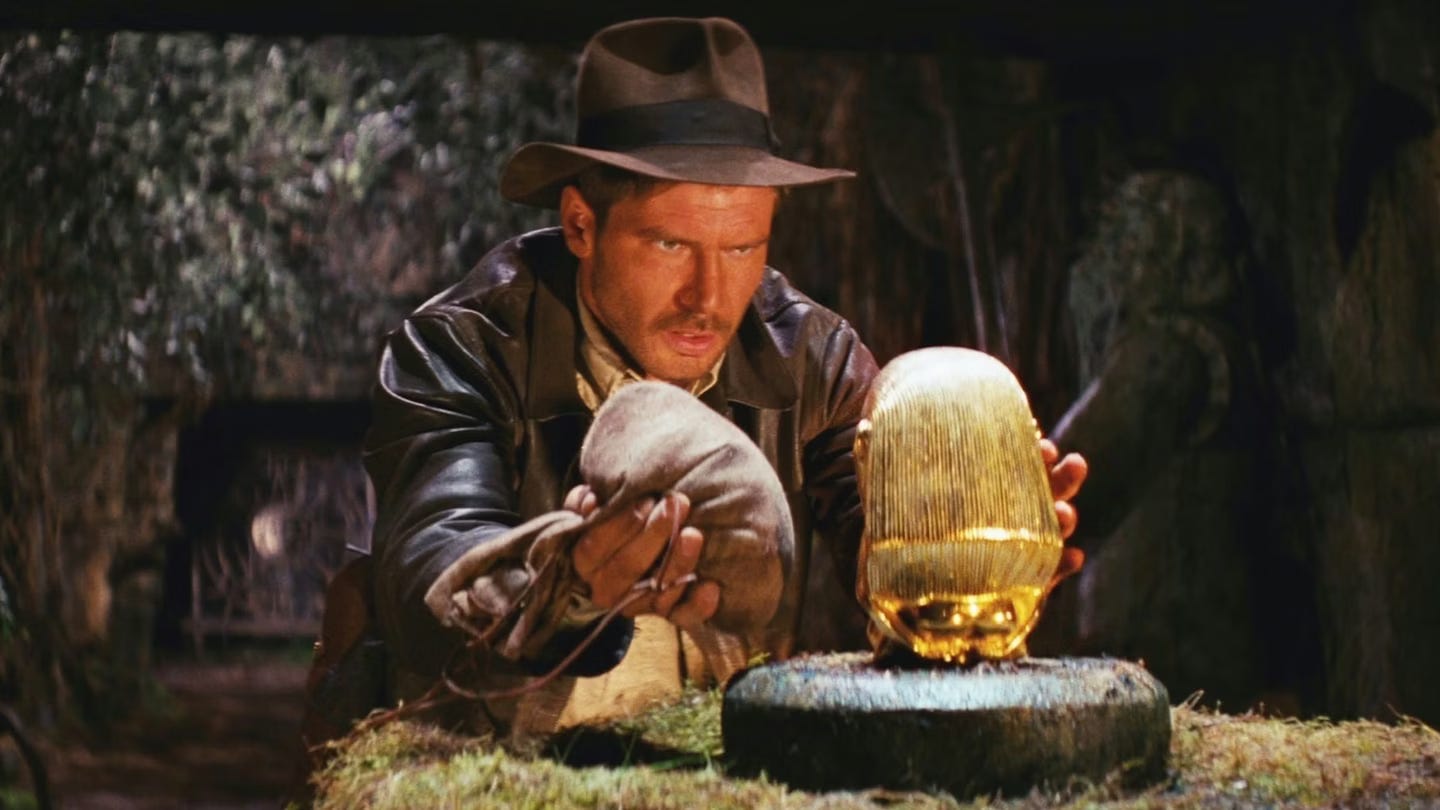
There’s a bit of meme film commentary going around right now, in the form of a critique of Raiders of the Lost Ark as presented by one of the characters from the sitcom The Big Bang Theory. It postulates that Indiana Jones had no effect on the events of the movie, and that without Jones the Nazis would still find the Ark, open it, and die.
While it’s fun to look at films from different angles to try to dismantle the logic, this take is incorrect. In the film’s prologue, Jones defeats the booby traps in a South American jungle temple to steal a golden idol, only to have it stolen by a rival archaeologist/fortune hunter, Belloq. We see that while Jones is the better man in every way, Belloq is able to side with a dominating army and steal Jones’ discovery.
This is then mirrored in the main story that follows, when Jones saves Marion’s life and takes the medallion, Jones finds a translation for the medallion, finds the secret to the hiding place for the Ark, and most importantly, realizes that looking into the Ark will kill him. And yet, Belloq has the resources of the German Army at his back, and has the upper hand for most of the film.
But it’s not surprising that the writing staff for a classic multicam sitcom would have this take, and it’s strictly because that’s a form that requires looking at story in a different way than screenwriting.
A great sitcom writer works in the constraints of a form where, even with long-term arcs, each episode must see the characters resist any kind of change so as to have a hard reset for the next week’s story. In sitcoms, the point is the effect that the character has on the story. A conflict is set up, and each character tackles that conflict according to the personality that has been established since the pilot.
Whereas in great screenwriting, the point is the effect that the story has on the character. We start Raiders of the Lost Ark introduced to Indiana Jones the swashbuckling heroic adventurer stealing treasure for glory and science. By the end of the film, he’s seen the evil of the Nazis, he understands what they will do if they can harness the power of the Ark, and he has had enough of a spiritual awakening to understand that one could never truly possess the Ark, because as soon as one looks into it, the Ark has possessed them.
In being commissioned by the United States Army, Indy has been given a professional stakes. In his race to capture the Ark before Belloq, he also has a personal stake. But in realizing the true power of the Ark, and the very real holy power contained within, he is given something he never bargained for: spiritual stakes that no mercenary archaeologist ever expects to find at the bottom of a dig.
The Indiana Jones who we meet at the start of Raiders is not the Indiana Jones we meet in The Last Crusade. That’s an Indy who, when asked by a modern Knight Templar if he seeks the Holy Grail for Christ’s glory or for his own, answers truthfully, “I just want to find my dad.”
You cannot beat the experience of watching a movie like The Fugitive in a crowded movie theater full of people who have also never seen it before. When Kimble finally puts the handcuffs on the one-armed man, there was a big cheer from the audience. Because it feels like a victory.
And when Gerard finally arrests Kimble, this feels like a victory too — because he has explained to Kimble that he believes him, that he has the evidence to prove he’s right, and then Kimble reciprocates by saving him from getting shot by the ultimate bad guy.
The neat trick that The Fugitive plays with its dual protagonist structure is that Richard Kimble is the nominal hero of the piece, racing law enforcement and time to prove his innocence and bring his wife’s killers to justice. But the character that actually goes on the hero’s journey is Sam Gerard. Kimble remains basically unchanged by the end, while it’s the Deputy Marshall who is actually affected by the events of the film.
There’s a classic way of writing characters where you establish what they want and what they need. For Richard Kimble, these are identical: to prove himself innocent and bring his wife’s killers to justice. For Sam Gerard, these are two distinct things. He wants to do his job and bring in his man. He needs to see justice done.
And that’s demonstrated in the final echo of that scene in the tunnels. In the back of Gerard’s Lincoln Town Car, he first uncuffs Richard Kimble and then gives him a cold compress for the injury to his face. Kimble tells him, “I thought you didn’t care.”
Gerard replies, “I do care a little. But don’t tell anybody.”
By the end of The Fugitive he allows himself to care, because it’s the right thing to do. A complex moral journey that, ultimately, ended in a triumph of good over evil.
Thank you for reading this far; you’ve truly completed your own personal hero’s journey. Next week we’re back to the funny, so if you aren’t a subscriber yet and want a dose of weird comic essays, personal stories, and cultural critique every Monday and Thursday, you can subscribe at the link below.
If you enjoyed this essay and want to share this with a friend, or if you thought the Raiders digression was a bit self-indulgent and want to punish a friend, you can do that with the push of a button: