

I was one of a very very select few 11 year-olds in the United States to be excited about the premiere of The Tracey Ullman Show on FOX in 1987. It was partly because my intense love of Monty Python’s Flying Circus had given me an appetite for more sketch comedy on television. But mostly because I’d read an advance article about it in the New York Daily News, in which it said that Matt Groening, of the Life in Hell weekly strip, had been given the job of making animated interstitials for the show.
At summer camp the previous year, a friend had introduced me to Groening’s strip and it literally changed me. I’d never seen a showcase for sardonic, dry, and furiously angry humor that spoke about all the things I’d seen both in my childhood and the wider world around me. The “Wheel of Fortune” panel in the following strip crystallized my entire worldview at that point (I was a different kind of kid):

Two years later, The Simpsons were spun off into their own series and I was there from episode 1. Although the first season was a little protozoic, all of the qualities that made it the cultural touchstone it would become were there from the beginning, and it became a huge sensation almost immediately. There’s no way that I can emphasize that last statement enough. It wasn’t just a hit, it was almost immediately woven into the American national cultural universal subconscious.
In a time when Bill Cosby had dominated the airwaves for years with his attempt to define the ideal nuclear family as the norm, causing probably hundreds of family sitcoms to blossom and die in his wake, The Simpsons presented a more familiar view of the family as a group of people who are trapped together, who love, tolerate, and want to murder each other, who learn to live with each other through a combination of hard work, attrition, and Stockholm Syndrome.
An industry bootlegging Simpsons shirts and selling them on the street popped up overnight, treating an animated sitcom like a major event, a sports team or concert, but permanently ensconced.
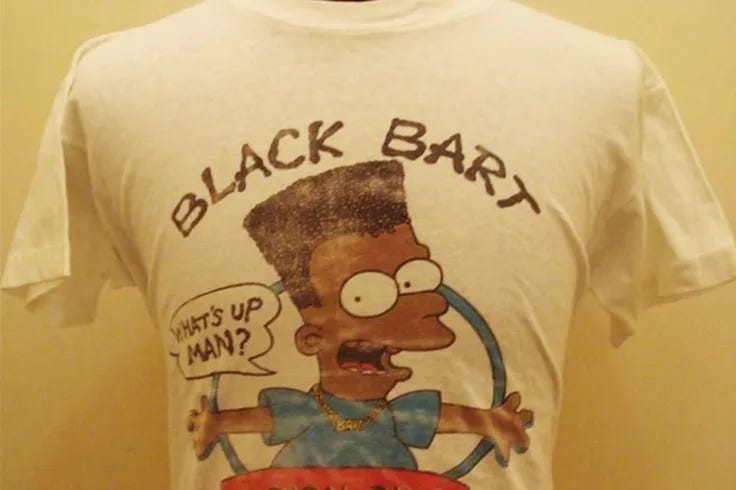
Sharing Groening’s clear vision of America at the end of the millennium felt both like I’d gained a wider granfalloon of people who felt that way (which turned out to be everybody) and also lost something special that only a relatively small number of us appreciated.
In the meantime, The Simpsons had also started to become controversial. Part of that, I think, had to do with FOX’s general overarching programming strategy, which seemed to be to bring to the airwaves shows that the other major networks considered in bad taste, or commercial kryptonite. It makes sense in retrospect, as a broadcast network attempting to make a name for itself in a marketplace dominated by three over-the-air networks that had been splitting the American viewing public for decades.
On the other hand, while it meant FOX took a risk on great shows like the multi-Emmy winning Tracey Ullman Show or the ahead-of-its-era Chris Elliot meta sitcom Get A Life (more on that some other day), it also aired a lot of crap, like a sitcom called Women In Prison, and a show called Herman’s Head.
But a big part of the controversy was of course, that Bart Simpson was a brat, who slacked off in school, mouthed off to every authority figure around him, and skateboarded. Don’t ask me why, but in the mid-1980s, Americans considered skateboarding akin to firing off Kalashnikovs in a public library.
And so, article after article was written about what a terrible influence Bart Simpson was among the imaginary army of children who disobeyed their parents, and ran around screaming Bart Simpson catchphrases like “Eat my shorts!”
Only. I really was an underachieving slacker who couldn’t make grades in school (I hated school, the feeling was mutual, and was dealing with other mental conditions as well which were not understood at the time and for which children were not yet being treated terribly efficiently.)
It also didn’t help that their friends had adopted a child with a severe attention deficit disorder who ran around like a tornado, making the adults in his life crazy and literally screaming “Eat my shorts!” at every adult he could see.
The long and short of it is that my parents forbade me to watch The Simpsons, and that ban was held up until, and I’m not exaggerating, I was an adult who no longer lived with them. Years later, I caught up with the first five or six seasons because my parents finally watched the show, realized how great it was, and became fans to the extent of buying the DVD season sets as they were released.
Now I am an adult and I have Disney Plus, and I’m watching all the Simpsons I missed through the years due to it being forbidden, or me being out every Sunday night doing standup, or me not being able to afford cable with a DVR.
Hot take: It's good, and as much as I’d always heard that the show declined in consistency, that happened a lot later in its run than I would have expected. I’m now about 24 seasons in, and there are some bad episodes, some weirdly off-brand episodes, but also some great episodes that remind one why this can still be one of the greatest achievements of the alf-hour TV art.
One of the things that’s jumped out at me as I watch the show is what a relic it’s become of the era in which it was created. At the time, it was still accepted as normal in America that a man with a decent but not great job would be the breadwinner for a family, buy a huge 4-bedroom house and two cars, while the mother stayed home and took care of the house. It seems as much a fantasy now as Bewitched, in which a nebbishy man could marry a woman way out of his league and demand she give up everything about her that’s special.
Below is one of my favorite ever gags, which comes after Homer has been banned from his favorite bar, Moe’s: