
The Business We've Chosen
A New Yorker in Los Angeles

They call New York “the city that never sleeps.” This unfairly minimizes the long hours put in by Los Angeles’ hardworking cocaine dealer community.
In October, it will have been ten years since I moved from New York City, my hometown, to Los Angeles, my adopted town. New York has an unearned reputation for being uncaring and dangerous, while Los Angeles has an overblown reputation for its laid-back mellow vibe.
L.A. is a town of Midwestern transplants, bringing with them the legendary “Midwestern nice”, a seething passive-aggressive rage that is hidden by a placid, smiling exterior, and brought into sharp relief by their behavior on the roads when they are safely anonymous behind the wheel of their large SUVs and can act out on the feelings they dare not name when face-to-face.
A culture exists here where one’s personal worth is measured in terms of career success. Small talk at parties, meetings, any kind of social gathering, will inevitably begin with an interrogation over where one works, what kind of work one does, and what they have achieved most recently. There is an anxiety over approaching a conversation without a fresh win to report.
The difference between fantasy and reality is the amount of work you’re willing to put in. What makes Los Angeles different is that it’s a city built on a fantasy of glamour, and it has attracted generations of the bright and the lazy who want to make their lives that fantasy without putting the work in.
And so. There is, as mentioned, a tool to help people achieve the feeling of success, avoiding all the boring steps of discovering a talent, spending years honing that talent, working your way to the top. That tool is cocaine, and it gives the user the instant rush that takes non-users years, sometimes decades to achieve.
Unsurprisingly, it is historically very popular in Los Angeles.
Slightly more surprising is its popularity among those who enjoy working for a living, who live for the conquest of the written word on the page, or the end of a 20-hour work day and the looming start of the next literally on the horizon. For them, it’s less of an escape and more of a tool to keep going.
All of these people do have one thing in common. One day they will move far far away from Los Angeles, with far far less money than they once had. If drugs are the lubricant, money is the accelerant. It funds the dreams that come true and drives the dreams that never will. It is the alpha and the omega, and the ultimate addiction in a town driven by them.
If you are a creative person, talented or not, Los Angeles first works upon your mental health. There is a sameness to those with creative abilities – a certain pride, arrogance, and devastating insecurity mixed into one – and the illness that infects everyone who moves here affects the talented and untalented alike.
The problem is this: Success never feels more possible than when you first move to Los Angeles. People you know are succeeding, and it will seem very quickly. You might be a standup comic and started with them at open mics. Or maybe you’re a musician and you played in a string of lousy bands together. Or you are an actor who went to classes with them, or you’re a writer who attended the same elite university with a pipeline to work with big paychecks attached.
You will see someone you know on a billboard, or featured in an article in an industry rag. Or you’ll be shopping for Japanese pears at Gelson’s and see someone you recognize from a hit TV show. Or you’ll be in line at the Coffee Bean & Tea Leaf behind a very successful director.
I have spent a lifetime in New York, and some time in London, in Paris, in Berlin. Unlike any other city on Earth, success in Los Angeles is physically close, so close you can almost grab it and make it your own. It’s the word “almost” in that sentence that can wear on a person, especially as they work a shift as a waitress or driving Uber Eats, serving those with more money.
In Los Angeles, it takes cocaine to ramp up and weed to slow everything down, and then rehab as a purifying ritual when the cycle runs too fast and you have still too much money to move away. If drugs are the playing pieces, then the game is the tightrope walk of success and ambition, and to win is to be the last to fall away.
And this is where the city finds its reputation for spirituality. The winners understand that there is a razor-thin line that separates them from the losers. They must believe the universe has a plan for them – and only for them – that they magically manifested. Because the alternative is that they’re just losers who got lucky.
To live here is to see that show business is a pirate ship. Those on board are grabbing as much money as they can, as quickly as they can, from as many projects as they can. And while it feels as if they spend just as much time repelling all boarders, as if it is a Darwinian system designed to guarantee the survival of the fittest, it is in reality something much more boring: A random crew who worked really hard and still know they are lucky to be there and are afraid of falling overboard.
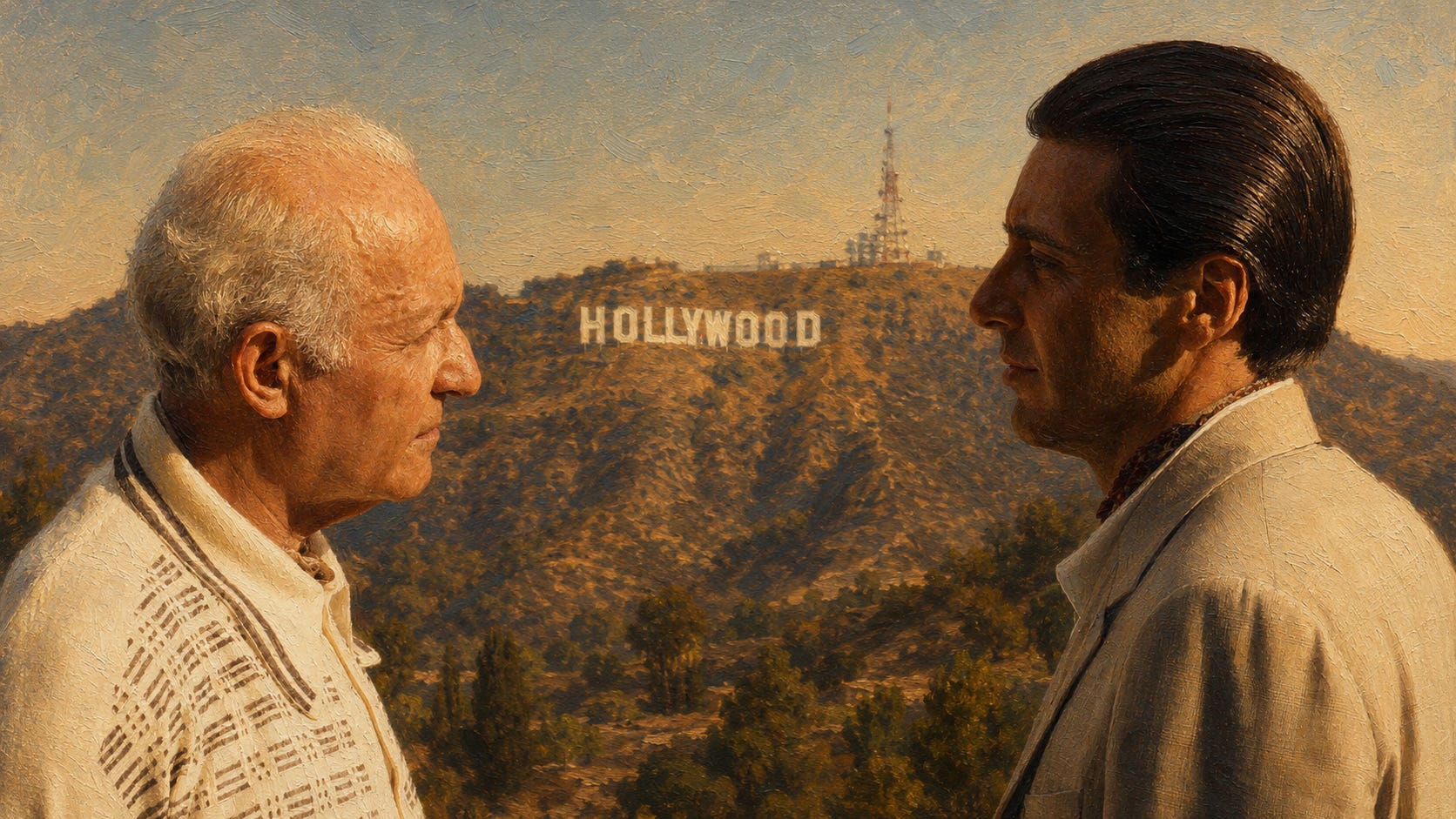
To tell you this is a kindness. To understand that everything that happens to, around, or adjacent to you has nothing to do with you personally is to understand that you can never be hurt by rejection. That it is not a measure of your talent or your inherent worth. It is instead a confluence of random happenstance and decisions made with no regard to you whatsoever. To quote Hyman Roth, the old Miami gangster in The Godfather Part II:
“This is the business we’ve chosen.”
This is a hard line delivered by a hard man about a friend who has been murdered on the order of MIchael Corleone, the man to whom he is speaking and the son of another hard friend. Roth has, up until this speech, been lucky in a tough business. It is intended as a warning, and yet it can be taken as a comfort. The trick to surviving Los Angeles is to hold on to yourself and be ready to change as everything changes around you.
As always thank you for reading. And if you’re a subscriber, you are truly appreciated.
And if you’re not: This Substack is subscriber-supported. You can get two posts a week in your inbox for free right here:
Please let the algorithm know you enjoyed this by hitting the like button below: