

It arrived in Tom’s inbox a second before he knew it was there. He was hunched over his cornflakes, pushing a banana slice around the bowl.
He’d been tired of bananas since he was a kid, but as any proud Clevelander was taught in grade school, ever since the Rust Belt Zone went tropical, it was their biggest crop. “Yellow gold”, they called it, and something about the redundancy of this phrase bothered him until he turned seven and the Implant went in.
Now, of course, the mention of “yellow gold” filled him with a regional pride.
He looked across the table at his wife, and he could tell by the way she jumped a bit that she’d gotten the email the same time he did. That’s the way the Implants worked; the part of his frontal lobe that had been sectioned off for communication and entertainment contained all of his emails, bills, spam, as memories of having read them.
Some people, like Tom, had no problems processing incoming communication as it landed. Others, like his wife Theresa, were sensitive to the effect of having a new memory jammed into their brain once every three minutes. He chalked it up to her having tested at 30 IQ points above his – and this was after the Implant. Some men he knew would have been upset at being married to someone that much smarter, but he reasoned he was free to watch his old movies while she did the work of worrying about things. They kept it quiet, and only their closest friends even had a clue.
He was reflecting on his memory of what the email had said while she was already staring him in the eyes, reacting. Her patience with his retention skills got lower the longer they were married, and this was their twenty-third year. After waiting an eternity of thirty seconds, she snapped:
“They’re going to take away Casablanca.”
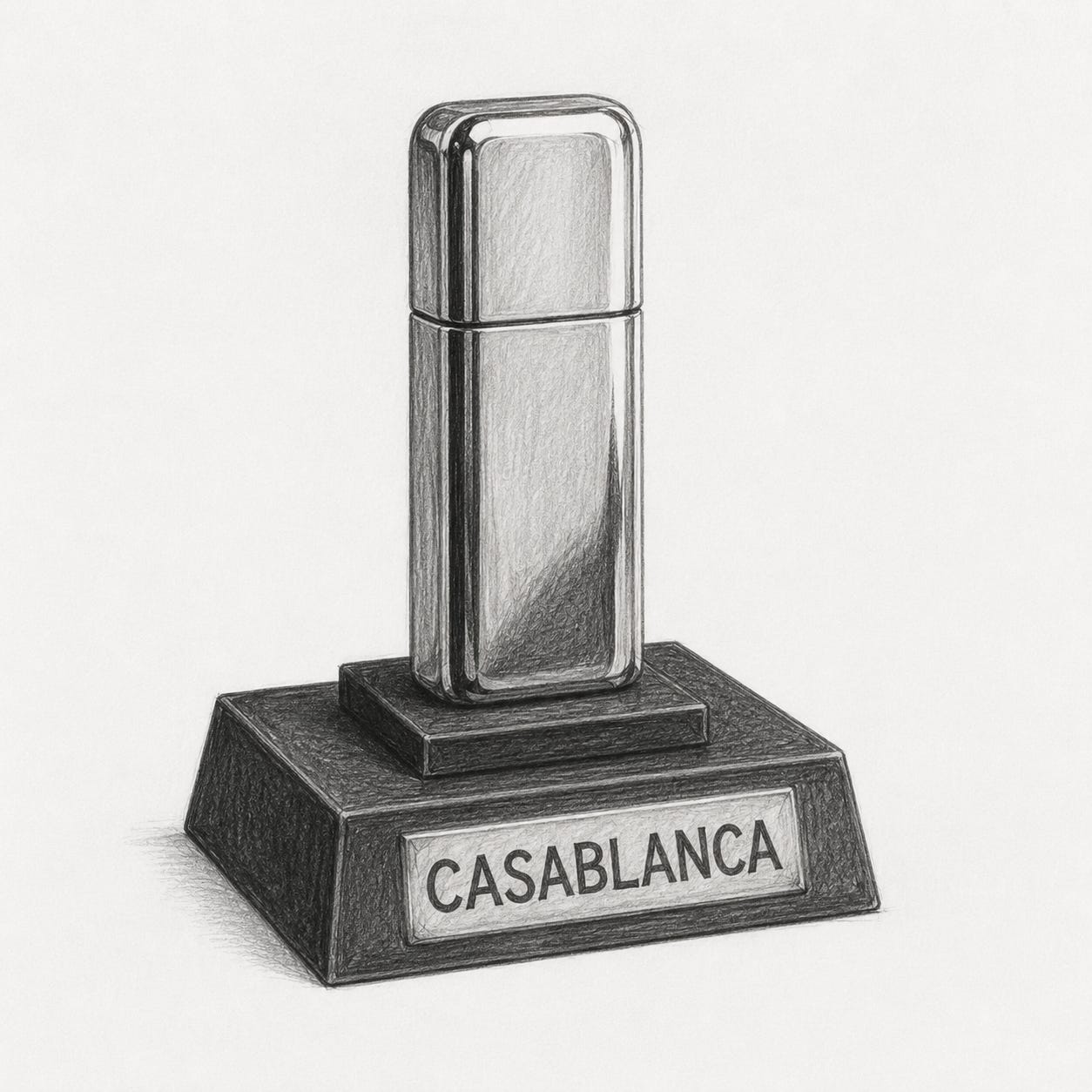
“But I have it on a 64k stick,” he muttered, waving impotently at his collection which took pride of place in the next room. A wall of bookcases contained a thousand chrome sticks, each placed on a tiny black cardboard pedestal with the name of a movie printed on it in cheap blue ink. He then waved his hand feebly over the array of small, rectangular chrome ports on his forearm, his index finger landing on the slightly dented, slightly rounded rectangular entertainment input.
“All I have to do is watch it again on my physical media.”
She snorted and shook her head. It was at this point that she knew she wanted to grab a pen and a piece of scratch paper to record some important information. But as the impulse arose, it was tamped down by an electrical charge in her brain.
A year earlier, she had begun to want to take notes almost all the time. She’d bought pads of tiny Post-It notes and a few pens. These had been expensive, but she knew at the time it had seemed worth the price. She didn’t think she ever actually took notes, but occasionally she would find little notes around their home with random names and titles.
“It doesn’t matter,” she explained carefully. She loved her husband, but sometimes she suspected he was being deliberately stupid, pretending to be this bad at processing information. She continued explaining, because at the end of the day the important point she really needed him to understand was that she was correct.
And so she pressed on, slowly, as if speaking to a small child:
“Our neural network has lost the license for the movie. It’s not a memory problem, it’s a license problem. No license, no storage. So not only will your memory be completely erased of having seen the film, any time you watch it and attempt to create a new memory of Casablanca it will be - erased - from your brain - as you watch it.”
He frowned, then gave her a half smile. She knew that meant he was trying to cheer her up. Somehow it had the opposite effect, and she resisted the urge to murder him.
“To see Casablanca for the first time all over again, that’ll be an experience.”
She picked up a scrap of paper lying face up on the table. It read: Emily Dickinson. Was this a friend of hers? Maybe from high school. She frowned, then crumbled the paper up and dumped it in her empty cereal bowl.
He poked at his cornflakes, then mumbled, “Great movie.”
“What movie?” She paused. Then, “Did you see we lost the license to Casablanca today?”
“You know, I have it in my physical media collection but I’ve never… I’ve never seen it. Let’s watch it tonight after dinner.”